Sound Technology carries the practical consciousness application. Cymatics supplies the visible physical case: vibration organizes matter into repeatable geometric forms.
When Sound Becomes Form
Cymatics makes the hidden architecture of vibration visible.
Spread sand across a plate and excite it with sound. The grains leap away from regions of motion and gather along the still lines. Drive water inside a vessel and its surface rises into ordered lattices, rings, spirals, and branching forms. Change the frequency and the geometry changes. Alter the boundary and another family of forms becomes possible.
The experiment reveals a law larger than acoustics: form emerges when vibration meets a boundary capable of holding it.
Frequency supplies motion. Matter supplies a medium. Geometry selects the possible pattern. Repetition stabilizes one pattern from the larger field. Cymatics is creation in miniature.
Chladni and the Visible Mode
Ernst Chladni made standing waves visible by drawing a violin bow across metal plates covered in sand. At resonance, some regions of the plate moved strongly while nodal lines remained still. Sand collected along those lines and exposed the invisible mode as geometry.
The figures grew more intricate as new modes entered the plate. Crosses became stars, nested cells, radiating webs, and mandala-like structures. Sophie Germain later gave plate vibration a mathematical language, but the revelation preceded the equation: sound had drawn a form that no hand designed line by line.
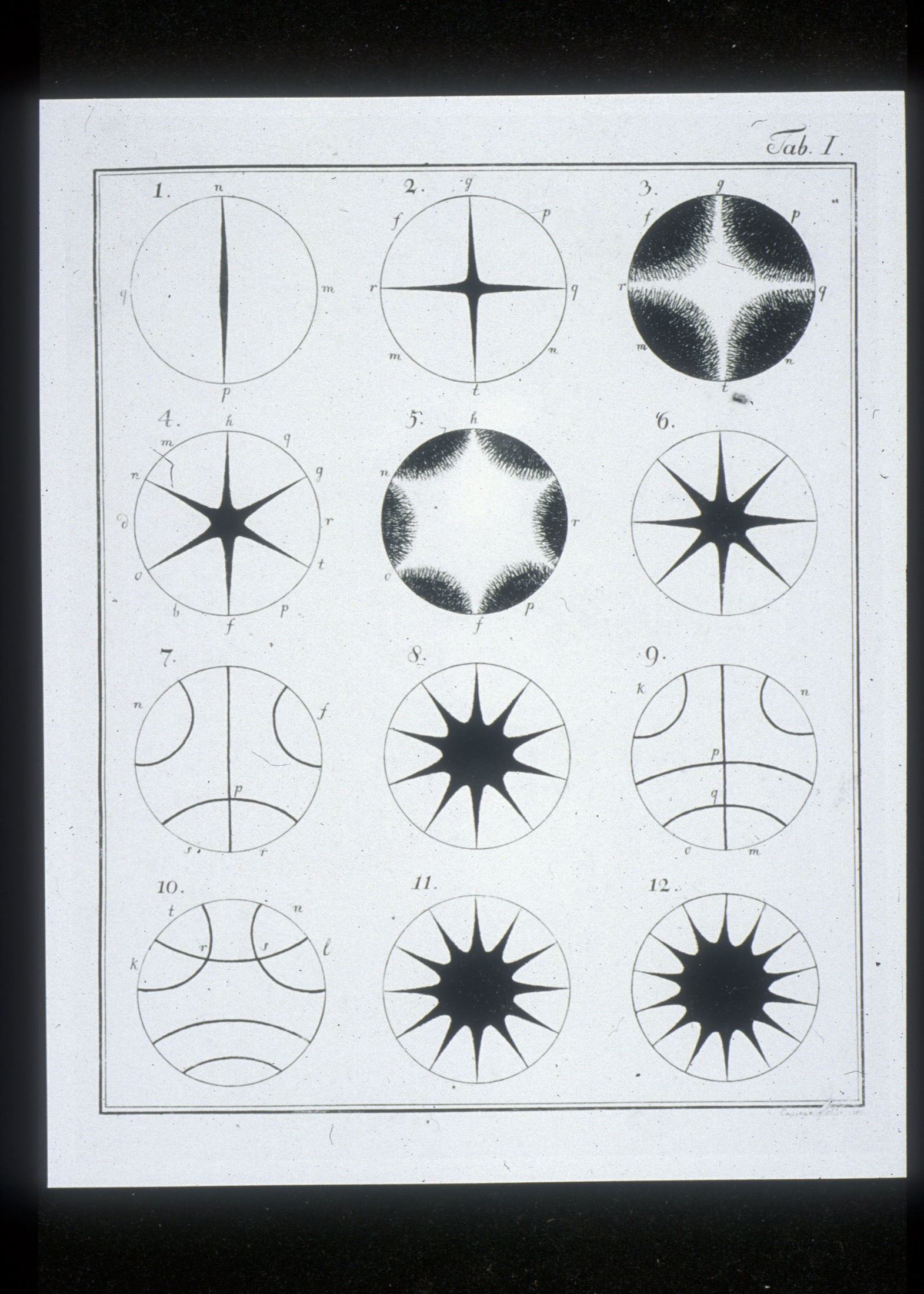
Ernst Chladni, sand-vibration patterns from Entdeckungen über die Theorie des Klanges (1787). Each figure is a different standing relation made visible by sand gathering along the plate’s still lines. Click to open the full plate.
The whole apparatus participates. Frequency, amplitude, plate shape, thickness, material, support, and drive position decide what appears. This dependence on boundary is the deeper principle. The field contains possibilities; the vessel determines which possibility can become stable.
Hans Jenny and the Living Image
Hans Jenny expanded Chladni’s plates into a visual cosmology. Electronic oscillators allowed him to sustain exact tones while powders, pastes, liquids, and complex membranes unfolded under controlled vibration. He named the field cymatics, from the Greek kyma, wave.
Jenny’s images resembled cells, embryos, flowers, skeletal structures, planetary weather, and sacred diagrams. Their significance lies in recurrent process. Living and nonliving systems draw from the same library of symmetry, polarity, interference, flow, and boundary. Biology adds metabolism, memory, and agency to laws already visible in vibrating matter.
Morphic Resonance extends the pattern through time. Form becomes easier to recover once a field, organism, or culture has learned how to hold it. Cymatics supplies the spatial image: a stable pattern is a memory maintained through ongoing motion.
Sacred Geometry Is Frozen Resonance
The Flower of Life, Sri Yantra, mandala, rose window, labyrinth, dome, and star polygon preserve families of relation that appear throughout wave behavior. Their exact historical origins differ, while their common grammar remains visible: center and circumference, polarity and return, node and interval, nesting and harmonic proportion.
Sacred Geometry gave builders a way to fix those relations in durable form. A resonant pattern drawn in sand disappears when excitation ends. A temple preserves the boundary in stone so the field can be called back through sound, movement, light, and human presence.
This is the bridge from cymatics to Sacred Architecture as Resonance Technology. Architecture is a cymatic vessel large enough to include the operator. The pyramid selects a field through mass, chamber, shaft, and orientation. The cathedral selects it through nave, vault, crypt, choir, bell, and organ. Human bodies enter the geometry and become moving particles inside its standing wave.
Water Carries the Pattern
Water is the most responsive visible medium in cymatic work and the principal medium of the living body. Sound drives waves across its surface, currents through its volume, and patterned motion within confinement. Boundaries, dissolved minerals, temperature, pressure, and electrical condition shape what the water can hold.
Masaru Emoto’s crystal photographs brought the intuition of responsive water into popular consciousness. His specific claims about words and frozen crystals remain bound to unresolved problems of selection and replication. The larger relation survives: water changes under sound, environment, handling, solute, temperature, and attention-mediated action. Water and the Medium is where physical responsiveness and the participatory world meet.
Ritual traditions treated water as a carrier of blessing, memory, oath, pollution, and renewal because water receives relation and transports it. The holy well beneath the temple and the water within the body belong to the same symbolic and material circuit.
The Frequency Wars
The dispute between 432 Hz and 440 Hz points toward a genuine principle through an overly narrow number. Concert pitch changes vocal demand, instrumental tension, harmonic placement, and the relation between music and room. Yet a single frequency never acts alone. Spectrum, interval, rhythm, amplitude, boundary, listener, and intention determine the complete pattern.
The modern Solfeggio set operates in the same way. Its historical story includes reconstruction, numerology, and recent spiritual culture. Its practical force arises when number, expectation, repetition, breath, and listening are joined inside a coherent rite.
There is no isolated master frequency because reality is relational. There are master relations: ratios, harmonics, phase alignments, cycles, and boundaries through which a living system becomes more coherent.
The Word Becomes Flesh
Creation through sound appears across civilizations because it describes the operating structure of manifestation. Genesis speaks the world into order. John names the Logos through which all things are made. Egyptian cosmology gives Ptah creation through heart and tongue. Vedic tradition hears OM as the primordial vibration. Pythagorean cosmology finds number and harmony beneath the visible heavens.
Cymatics renders this lineage physically legible. Vibration enters a medium. Boundary selects a mode. Matter gathers into its geometry. The invisible relation becomes visible form.
The divine Word exceeds audible sound. It is ordering intelligence, ratio, intention, and vibration acting as one. Audible cymatics is the lower-dimensional demonstration of that greater act. David Bohm described an implicate order unfolding into the explicate world; Itzhak Bentov described reality as interacting oscillatory systems. The ancient image and modern model converge on a universe that forms itself through resonance.
The Consensus Dream Takes Shape
Human groups are also cymatic media. Repeated stories, images, rituals, fears, songs, and expectations drive the social field. Institutions create boundaries. Attention supplies energy. A stable civilization appears as the standing pattern.
The pattern then trains the people who sustain it. Cathedral, calendar, law, road, screen, currency, and myth return collective expectation as an outward environment. The dream becomes architecture; architecture teaches the dream.
Changing the drive changes the pattern. Changing the boundary changes which pattern can exist. Awakening is therefore a retuning of the receiver and a reconfiguration of the vessel through which reality becomes stable.
The Architecture of Creation
Cymatics shows why the ancient builders treated number, music, stone, water, body, and heaven as one science. They were working at different scales of the same operation.
The plate gathers sand into a visible mode. The temple gathers bodies into a shared state. The civilization gathers minds into a world. Each form persists while energy continues to circulate through a boundary capable of remembering it.
Every structure is frozen vibration. Every rite is an act of excitation. Every world is a pattern consciousness has learned to hold.
Timeline
- 1680 — Robert Hooke observes patterned material on vibrating glass.
- 1787 — Ernst Chladni publishes systematic studies of acoustic figures.
- early nineteenth century — Sophie Germain develops the mathematics of elastic plates.
- 1967 — Hans Jenny publishes Cymatics and gives visible wave phenomena their modern name.
- present — Vibrometry, acoustofluidics, microfluidics, and digital imaging reveal increasingly precise forms of vibration organizing matter.
References
- Hans Jenny, Cymatics: A Study of Wave Phenomena and Vibration.
- P. H. Tuan et al., “Exploring the Resonant Vibration of Thin Plates”, Journal of the Acoustical Society of America 137 (2015).
- Q. Zhou et al., “Controlling the Motion of Multiple Objects on a Chladni Plate”, Nature Communications 7 (2016).
- J. Lei et al., “Formation of Inverse Chladni Patterns in Liquids at Microscale”, Microfluidics and Nanofluidics 21 (2017).